Why Some Book and Video Game Adaptations Work on Screen—and Others Don’t
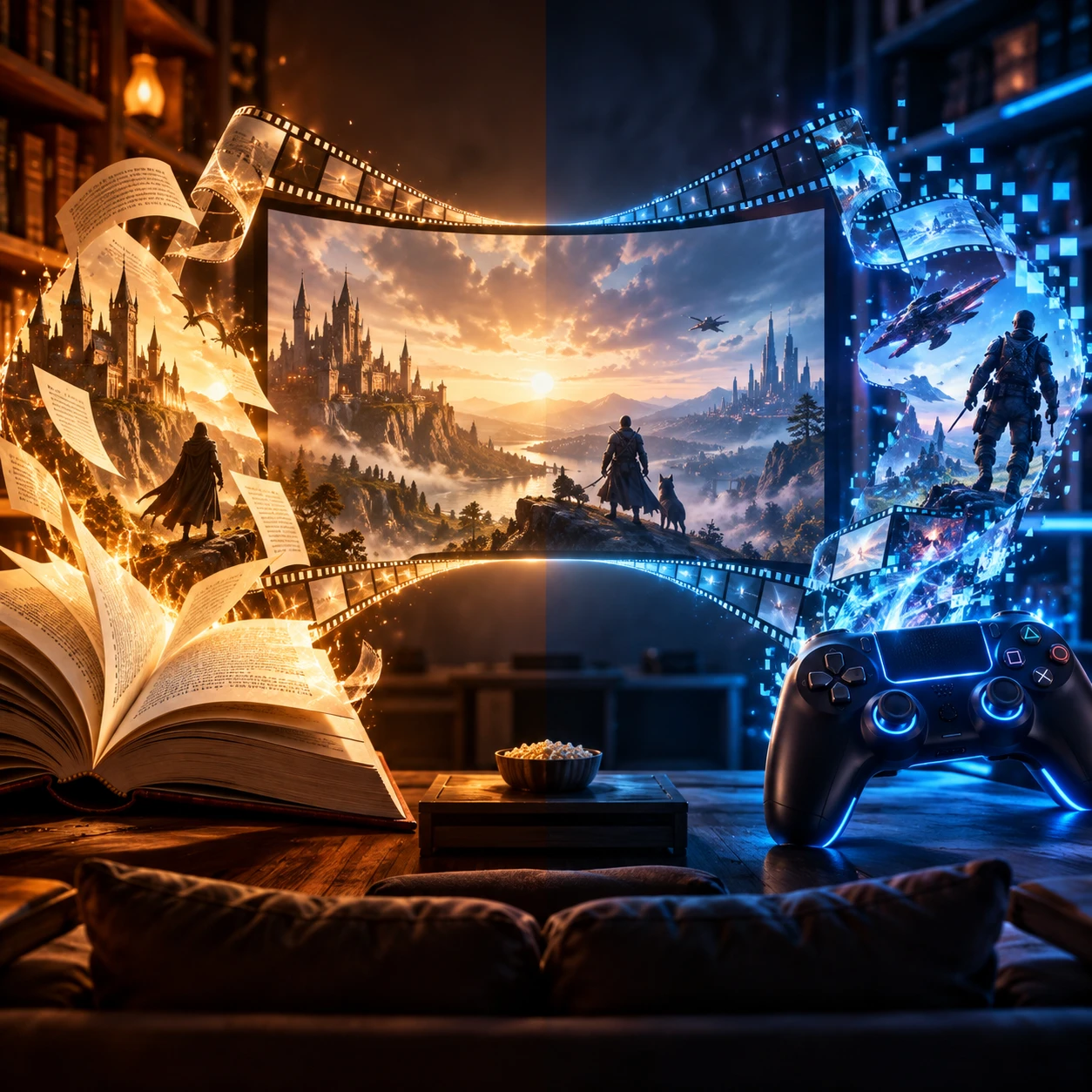
A screen adaptation can preserve a source material’s most recognizable details and still feel lifeless. Another may change characters, chronology, or entire plotlines yet capture what made the original compelling. The difference often lies in whether the filmmakers understand what each medium does best—and make deliberate choices to tell a coherent story on screen.
Books and games pose different challenges. A novel gives readers access to language and inner thought; a game gives players agency through choices and action. Comparing their film and TV adaptations means looking beyond a checklist of familiar scenes to ask what the screen version keeps, changes, and makes possible.
What Makes an Adaptation More Than a Copy?
An adaptation is a new version of a story shaped for a different medium. It succeeds when its creative changes preserve the source’s defining qualities while giving viewers a clear, engaging experience of their own.
A book-to-screen production cannot reproduce every sentence, and a video game adaptation cannot make watching equivalent to playing. Film and TV series rely on images, sound, performance, editing, and pacing. The task is to translate meaning and dramatic effect, not simply transfer content.
That distinction helps separate fidelity to details from fidelity to a story’s core. A screen version might rearrange events but retain a character’s central conflict, the world’s moral logic, or the atmosphere that gives the source its identity. Conversely, it can include famous lines and familiar costumes while losing the emotional stakes that made those details matter.
A useful first question is: what experience does the source offer that the adaptation must replace or recreate? For a novel, the answer might be a distinctive voice or a gradual change in a character’s beliefs. For a game, it could be exploration, risk, or responsibility for a decision. Once that core is clear, creative changes become easier to judge.
Adapting Books: From Inner Thoughts to Visual Storytelling
Book adaptations must turn prose, internal thought, and a reader’s imagination into visible action and sound. That often means compressing events, finding visual ways to express a character’s inner journey, and rebuilding the original’s pacing for film or television.
Novels can pause for pages inside a character’s mind. A movie has limited time, while a TV series can spread the journey across episodes but still needs scenes that hold attention. A voice-over may preserve a narrator’s perspective, but using it to explain every thought can make the screen story feel static. A glance at a letter, a choice avoided, or a repeated action can communicate more naturally.
Pacing is another major translation problem. A novel may spend many chapters establishing a world before its main conflict takes shape. A film might need to introduce the central problem earlier; a series can devote an episode to atmosphere, provided it also creates momentum. Neither format is automatically better. The right choice depends on how much the plot, relationships, and worldbuilding need to develop.
Compression also carries a cost. Combining characters or removing a subplot can clarify a film’s narrative structure, but it may erase a relationship or theme that gave the source its depth. The key is to preserve the function of what is cut. If a subplot shows a protagonist learning to trust, the adaptation should give that change another convincing path.
Adapting Games: Turning Player Agency Into a Screen Story
Video game adaptations must turn player-controlled action and choice into a story that unfolds for viewers. They work best when they preserve the game’s distinctive world, conflicts, or emotional stakes without pretending that passive viewing offers the same agency as play.
Games can let players explore at their own pace, fail, retry, and make decisions. A film or TV series has to choose a sequence of events and show it to everyone. That change can weaken a story built around personal responsibility if the screen version treats consequential choices as decoration or simply removes them without replacing their dramatic purpose.
Sometimes the solution is to focus on elements that do not depend on player control: the setting, a central relationship, a mystery, or the consequences of living in the game’s world. Other adaptations can use a protagonist who faces meaningful decisions, even though viewers cannot make those decisions themselves. The challenge is to make the choices revealing and consequential, rather than implying that the audience is playing along.
Gameplay itself needs selective translation. Repeated combat, collecting items, or navigating levels may be satisfying in play but tedious if copied beat for beat on screen. Action scenes need character stakes and variation; worldbuilding should emerge through conflict and behavior, not only through explanations. A video game adaptation can retain recognizable imagery while building a narrative structure designed for film or television.
The Choices That Help an Adaptation Succeed
A successful adaptation tells a clear story, makes purposeful creative changes, and preserves the source’s defining qualities. Strong performances and a format suited to the material help those choices land for both longtime fans and newcomers.
A practical way to evaluate the creative approach is the Core–Medium–Audience test:
- Core: Identify the source’s essential appeal: a character’s transformation, a relationship, a moral dilemma, an atmosphere, or a world with distinctive rules.
- Medium: Ask how film or television can express that appeal through images, sound, acting, editing, and episode structure. For a game, consider what replaces player agency; for a book, consider what replaces prose and interiority.
- Audience: Check whether viewers can follow the story without prior knowledge, while fans still recognize the source’s identity and emotional logic.
Purposeful change is the hinge between these questions. A removed subplot may sharpen the main conflict; a new scene may make a private motivation visible. But a change should have a dramatic reason. If it exists only to surprise fans, it may attract attention without strengthening character development.
Performances matter because screen stories rely on faces, voices, and physical choices to convey meaning. A well-cast actor can make a familiar character feel specific, while direction and production design can make worldbuilding legible without lengthy exposition. These strengths do not guarantee success, but they give viewers something vivid to follow.
Why Adaptations Fall Short
Adaptations often fall short when they rush the plot, weaken characterization, or mistake recognizable references for storytelling. They also struggle when creative changes leave the story unclear about its audience or its central purpose.
Common missteps include:
- Rushing essential turns: A film may compress so much that a character’s change feels unearned. Identify which decisions cause the transformation, then preserve those turning points even if other events must go.
- Adding fan service without a story function: Familiar names, objects, and scenes can delight fans, but repeated references may confuse newcomers or interrupt the narrative. Keep a reference when it reveals character, advances the plot, or deepens the world.
- Flattening characters: An adaptation may retain a hero’s appearance while removing the flaws, doubts, or relationships that make the character compelling. Track what the protagonist wants, what stands in the way, and how the conflict changes them.
- Choosing a format that fights the material: A sprawling story can feel hurried as a film; a compact plot can feel stretched across a series. Match the format to the story’s necessary development, not merely to its popularity.
These errors usually come from treating the source as a collection of marketable parts rather than a working narrative. Familiarity can help viewers connect, but it cannot replace clear stakes or earned emotion. Newcomers need enough context to care; fans need more than a sequence of nods.
A Better Way to Compare Adaptations
Compare an adaptation with its source on two levels: how well it works as a screen story, and how thoughtfully it transforms the original. This avoids treating literal fidelity as the only measure of quality.
Start with the screen version on its own terms. Is the plot understandable? Do character decisions have consequences? Does the pacing suit a film or TV series? Are the performances and worldbuilding helping viewers follow the story? These questions matter even if someone has never read the book or played the game.
Then compare the adaptation with its source material. Look at what it preserves, what it changes, and whether those changes make sense for the new medium. A rearranged storyline may be effective if it builds suspense; a removed game mechanic may be sensible if its dramatic purpose appears elsewhere. Ask whether the adaptation keeps the source’s emotional or thematic center, not whether every event matches.
This two-part method also makes room for honest trade-offs. A movie may deliver a focused character arc but sacrifice the slow worldbuilding a novel could sustain. A series may give relationships more room while losing the urgency of a tightly structured game. A version can be strong as a film and imperfect as an adaptation, or deeply recognizable yet dramatically weak.
Does a screen adaptation need to be faithful to its source?
No. It needs a clear relationship to the source, but that relationship may involve changes to plot, character, or structure. Fidelity is most useful when it preserves the qualities that make the original meaningful, rather than insisting on identical events.
Why are video games difficult to adapt into films or TV series?
Games give players control over pace, exploration, and sometimes major choices. Films and series present a fixed sequence, so the adaptation must replace the dramatic function of player agency while shaping gameplay into scenes with clear stakes.
Can a TV series adapt a book better than a movie?
Sometimes. A series can devote more time to relationships, subplots, and gradual character development, while a movie can give a story focus and momentum. The better format depends on how much material the story needs, not on a universal rule.
What makes an adaptation appeal to people unfamiliar with the source?
Clear stakes, understandable characters, and worldbuilding woven into the action help newcomers follow the story. A viewer should not need to recognize references or know the original’s rules before caring about what happens.